|
By: Kristin P., Vancouver, BC
In the middle of newspaper articles and TV clips showing protestors facing off with police in riot gear, you may have heard the word "globalization" repeatedly. Globalization is a common theme that is connecting really diverse groups of people together to protest--the new "four letter word" of social justice, environmental, student and trade union movements. While people might differ on what globalization is, it generally refers to how the World Trade Organization, International Monetary Fund, World Bank, and other institutions--the globalization giants--are re-writing the rules of international trade and investment to create a new kind of global economy. Before your eyes glaze over after reading that previous sentenceÉwhen I used to hear the word "economics" I'd totally tune out; economics seemed to me something remote and complicated, kind of like physics or calculus. But gradually I started paying more attention as I realized that the things I really care about--poverty, the environment, access to good healthcare and education--are hugely affected by what's going on in the global economy. At the centre of protestor's concerns with globalization is who is benefitting from the rules that are being written. Protestors believe that the rules and decisions being made in these institutions are being made for the benefit of corporations and those that control them at the expense of the rest of us, especially the poor, the oppressed and the marginalized. You've heard the saying "the rich get richer and the poor get poorer"? That's a pretty good summary of what protestors think the "globalization giants" are doing. All of this may seem pretty vague and maybe even a bit conspiracy theory-ish. So here's a few more concrete ways that the global economy is being changed and influenced. Free trade agreements Free trade is one of the ways the corporations and other wealthy and powerful organizations and individuals are pursuing corporate globalization. The WTO is the grand-daddy of them all, with 135 member countries. But free trade is also being pursued through many different agreements and bodies, including: - APEC (The Asia Pacific Economic Cooperation). Remember the 1997 "Pepper spray" protests in VancouverÉ - The FTAA (Free Trade Agreement of the Americas) is being pushed by the OAS (Organization of the American States) and the Summit of the Americas. This is what the June protests of the OAS General Assembly in Windsor, Ontario were all about. - And many more in Africa, the Caribbean, etc. Check out Alison and Alayne's article on the WTO for some more details on why people are opposing free trade. IMF and the World Bank How do the IMF and the World Bank fit into this? The World Bank and the IMF loan money to countries, mostly in the south--developing countries. Doesn't sound too bad, does it? Well, here's how it usually happens: - Poor countries are burdened by debt, and desperate for loans. - They turn to their last resort, the World Bank or the IMF. - The IMF and the World Bank grant loans with lots of strings attached. This is called "structural adjustment policy" (SAPs). Basically, SAPs change the way a country's economy works by ensuring a corporate friendly environment, including: - tax breaks and subsidies to corporations - the reduction of wages and elimination of some labour laws - selling government utilities and access to natural resources to corporations at rock bottom prices At the same time, SAPs also reduce government spending on health and education and basic necessities. This frees up more money to pay back loans but hurts the poor, who rely more on social spending. Some of the effects? School fees go up and poor children can't afford basic education. Illiteracy increases, especially among girls who are often pulled first from schools. Higher fees for health services means less treatment and medicine is available, especially to those who can't afford to pay. Predictably, preventable diseases and deaths increase as a result. And when government subsidies for basic goods are cut, the prices of basic survival items like bread and rice, increase dramatically and more people go hungry. And at the same time this is happening, corporations are getting tax breaks and bargain prices on wages and resourcesÉ.again, corporations and their owners are benefitting while poor people lose out. What about democracy? Protestors are also raising concerns about the way decisions are being made by the globalization giants: - At the IMF and World Bank, a country's voting power is determined by how much money it contributes. This means that rich countries control the IMF and World Bank and therefore have a huge amount of power over the economic policies of poor countries. The 7 largest industrialized countries hold 45% of the vote; the U.S. alone holds 17% of the vote. This raises questions over whose interest IMF and World Bank policies work for those of the poor and powerless? Or those of the wealthy and in control? - The WTO has the authority to strike down laws and policies that are made by democratically elected governments (See the WTO article for examples of what kinds of laws are being struck down). This means that decisions made by an unelected panel of trade bureaucrats are over-ruling decisions made by elected governments. Because these panels are unelected, citizens have little ability to influence their decisions and so the concerns and wishes of citizens can be ignored. So if we don't want Corporate Globalization, what do we want? Opposing the Globalization Giants is just a start and isn't the only way that people are taking action. People in the north and south are creating real alternatives to corporate globalization. And while activists may agree on what they DON'T want, agreeing on what they DO want is a larger challenge! But again, there are common goals. Proposed alternatives put people first, the poor, the marginalized, and the majority should be the ones that are benefitting from trade, investment and development. Alternatives range from small, every-day steps (like buying fair trade coffee) to the more system-shaking restructuring (debt relief, Cuba). You can show your support for big changes in small ways by being an informed consumer, writing a letter, volunteering with an organization, attending a protest. There's a world of alternatives out there . I've provided some key words below, and some websites where you can start looking.... Alternatives - keywords - fair trade - debt relief, Jubilee 2000 - community development - social clauses in trade agreements - corporate social responsibility - ethical investing - informed consumers - Cuba Where to lookÉ. If you want to get informed, and get active, here's some websites where you can start looking. You can check out "both sides" of the debate by exploring the activists and alternatives AND the globalization giant's websites. Activists and Alternatives. - Global Exchange: www.globalexchange.org - One World: www.oneworld.org - Jubilee 2000 (debt relief): www.jubilee2000.org - The New Internationalist: www.oneworld.org/ni - Council of Canadians: www.canadians.org The Globalization Giants - World Bank: www.worldbank.org - IMF: www.imf.org - OAS: www.oas.org - WTO: www.wto.org
Before you check out these websites, here's some things to keep in mind - good to apply to any media, whether you read it or watch it on TV (including my article!)
Evaluating the Arguments 1. Who is writing what you're reading? 2. What "interests" do they have? 3. How are those interests connected with what they're promoting? (ex. a corporation's interests are to increase it's profits. If the head of a corporation is influencing decisions, how are these decisions connected to the corporation's interests of increasing profits?) 4. Are their interests the same as yours?
|
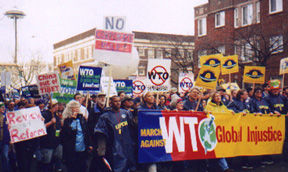 Protests against the WTO, protests against the IMF and the
World Bank, protests against the FTAA. What's with all these acronyms?
And how are they all connected?
Protests against the WTO, protests against the IMF and the
World Bank, protests against the FTAA. What's with all these acronyms?
And how are they all connected?