 |
by Anonymous |
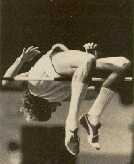
Greg Joy stared at the slim metal rod, hanging exactly 7'7" above the floorboards of the arena in College Park, Maryland. Joy took several deep breaths, rocked back and forth a moment, then sprinted toward the bar. At the last moment, he pivoted backwards and flung himself into the air. Joy's head and body had already cleared the bar and were heading back towards the ground when his legs were still below the bar. Just before his legs collided with the bar, Joy performed a reverse jacknife kick, throwing his legs over the bar. When Joy landed on the foam-filled mattress, the bar was still in place.
7'7"! Greg Joy, a young Canadian from Vancouver who now makes his home in Florida, had set a new world indoor high jump record! It had been more than a decade since any Canadian track and field athlete could claim part of a world record. But Joy claims he knew it was coming.
 |
The Greg Joy story really began back at the Montreal Olympics on a rainy August Saturday afternoon. "When I went to the Olympics, no one took much notice of me," Joy says acidly. "But I was there to win. When I won the silver medal, I felt that I had done no better than I was capable of doing. I have always known that I could jump very well."
|
The rest of the world had no idea that Greg Joy was a contender in the Olympics. Joy's performance came as a surprise even to the Canadian track and field contingent; in the pre-Olympic publicity, barely a word had been devoted to this unknown jumper. But, as the chilly, very wet afternoon, the last day of the Olympic competition, wore on, and the other jumpers fell by the wayside, it became a three-way duel between Joy, American Dwight Stones and Poland's Jack Wszola.
Stones, the world indoor and outdoor record holder, was the clear favorite. But the takeoff area, slick with rain, bothered him (he claimed later) and the results were utterly unexpected. Stones had to settle for a bronze medal, leaving Joy and the Pole to fight it out. Joy and Wszola cleared the same but Joy, with more misses during attempts at lower heights, lost out.
Since the Olympics, Joy has jumped consistently but not spectacularly, not an uncommon occurrence in the post-Olympic year. Many athletes slack off immediately after a good Olympic performance and only begin to come into their own again more than a year later. For Joy, the 1978 indoor season demonstrated his abilities.
"I knew that I could get the indoor record this year," Joy announced. (High jumpers, it should be added, are often outspoken. They train on their own, live their own lives, and relay on their own egos to psych themselves up for competition). "The real problem is that conditions indoors are not very good. Even when I set the world record, I had to run between holes where the floor boards were not properly joined together. The conditions make it very difficult to concentrate." At the Maple Leaf Gardens meet in Toronto during February, Joy won the high jump event at 7'-4-1/4" but missed when the bar was raised another two inches. "I could have gone over 7'-6-1/4" without any trouble," Joy complained. "But I hit a crack just before my take-off and I couldn't stop because I was all psyched up' for the jump."
Even with the world record, Joy has not enjoyed considerable acclaim. A Toronto newspaper columnist reported a lengthy conversation during which Joy criticized the Canadian government for failing to recognize his accomplishments. According to Joy, no one in Ottawa even took the time to call or write to congratulate him on his achievement. It was a good point; Joy deserved more attention.
But the record was short-lived. The following week, a 5'8" jumper from just outside New York cleared 7'7-1/4" to beat Joy's mark. And suddenly the name Franklin Jacobs was dominating track talk.
Jacobs is a sportscaster's delight. Unlike the tall, obviously athletic Joy, Jacobs is an unlikely athletic hero. He starts off with his head a full 6" lower than Joy and clears the bar with a style that can only be called unusual. World records that last only a week are not the stuff of which great heroes are made, either.
Then there's Dwight Stones, the American jumper with the big mouth. Joy has lived in Stone's shadow, even though he beat the American at the only meet that really matters, the Olympics. Stones has a mouth that never stops and is best described as the Mohammed Ali of the track world. Recently, he has been telling reporters that his presence alone is enough to psych Joy out of jumping well at any meet.
"That's ridiculous," Joy snorts. "I can jump against Stones any place and any time. Nothing gives me greater pleasure than to kick his butt." Unless, of course, it's kicking the butt of Franklin Jacobs.
And what lies ahead for Joy? He will likely remain in the United States even though he continues to compete for the Richmond, B.C. Kajaks. "Florida is an excellent climate for a Jumper," he says, looking as if the subject needs no further explanation. The next Olympic Games are in Moscow in 1980. And that's where Greg Joy will probably end his athletic career.
Two years of hard work, training daily in his search for the ultimate track and field award-an Olympic Gold Medal. That's the way Greg Joy will spend the next part of his life. A tough life but the way this remarkable athlete, a man who has proven he can take on the biggest challenges and excel, chooses to live.
Greg Joy: another reason for being proud to be a Canadian.
©1999 TG Magazine/Le Magazine TG
tgmag@tgmag.ca