 |
by Jim Smith |
Marty grew up a couple of hundred miles north of Edmonton, where winter starts early and lasts until long after the daffodils are out in Vancouver and Halifax.
When the wind howls and the snow flies, fellows like Marty huddle up with the television set and watch the NHL hockey games. When the wind dies down a bit, they bundle up, tie on their skates, clear a homemade rink and practice for the day when they'll be in the NHL themselves. In hundreds of northern towns like Marty's, hockey is always more than just a game; hockey is a way of life.
Not surprisingly, Marty shared that common dream. He knew that he had talent; he knew that he could score with the hockey big leagues.
When I first saw Marty, he was playing Junior C hockey in Southern Ontario. Junior hockey is for players under 20 and the quality goes down as you move farther down the alphabet. Junior A, for example, is semi-professional hockey, the league in which you'll find tomorrow's Bobby Orrs. Junior B isn't bad but it's not Junior A, either. And Junior C -even though the players are generally paid modestly - is the bush league.
In Junior C, Marty did rather well. His strength allowed him to manhandle most of the other players and he developed a fair shot. But, even in that league, his limitations were obvious, too. He lacked blinding speed, even though he practised his skating religiously. His reflexes were just a shade too slow; I saw him miss too many faceoffs. And he had trouble anticipating the moves of opposing players.
But Marty insisted on following his dream. He passed up the last years of high school in favour of hockey and never got near a college. His winters were spent practicising and playing; his summers were devoted to weight lifting, running and hockey clinics. No one ever tried harder to become a professional athlete.
Marty never made the NHL. He spent a couple of years playing semi-professional senior hockey, tried out for and was passed over by every major league team. Finally, his dream shattered, he went back to northern Alberta to work his father's farm. How does he feel about his decision to gamble everything on a hockey career? "I was stupid," he acknowledges bitterly.
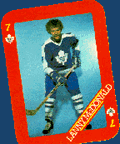
About the same time that Marty was beating his brains out in senior hockey, another kid from a little Alberta town decided to drop out of university after half a year and gambled on making a living shooting little black rubber discs through some upright pipes. This other kid was built much like Marty: six feet tall, rugged and awesomely powerful. But that's where the similarities ended; the other kid, after dominating the Western Canada Junior Hockey League, went on to become the second-highest scorer and one of the most popular players in the history of the Toronto Maple Leafs. Just turned 26, Lanny's best years are probably still ahead of him and yet he's already accomplished what only a handful of other players -names like Hull, Howe and Orr -have managed in the past.
Lanny has succeeded as spectacularly as Marty failed. So it seemed reasonable to expect Lanny to feel as positive about careers in professional hockey as Marty feels negative. To my surprise, however, Lanny shares many of Marty's attitudes.
Honesty seems to be Lanny's strong suit and anyone who is even casually interested in pursuing hockey as a career should take some time to reflect on Lanny's refreshingly open advice.
"The odds are very much against most hockey players ever coming close to playing for the NHL," Lanny points out. "The game has been very good to me and put me in the position where I'm able to earn my living doing what I like best. But most young hockey players won't be that fortunate.
"I believe that only about one out of every thousand fellows who start out playing some sort of organized hockey ever get to play Junior hockey. And only a small number of the Junior players go on to play in the NHL." For every 10,000 boys who set out to earn a job with the NHL, one will succeed. But that's only the tip of the iceberg.
Lanny also explains that the majority of NHL players last for only a very few years before injuries or younger, better players force them into retirement. Security is unknown; the fight to keep a job is as tough as any of the bonebreaking plays on the ice. "As recently as five years ago," Lanny has found, "the average NHL player would be able to stay in the league for ten to twelve years. Now the average length of an NHL career has dropped to six or eight years. And, five years from now, the average will be down to about five years." Hundreds of talented young players have lasted less than a single season.
"The length of an NHL career is very important," Lanny notes. "It isn't possible to set aside enough money from five years of hockey to provide financial security for the rest of your life. Most hockey players must find another career just to stay alive after their NHL days are over. You can't start another career unless you have some education, though." Tragically, most young hockey players ignore their educations as they concentrate on the sport.
Junior hockey and education don't mix well, Lanny admits. "I was luckier than many other players," he says. "I was able to start school a year ealier than normal so I had graduated from high school by the time I was 17. But I discovered during my first year of university that it just isn't possible to play Junior A hockey and do well at school, too. The strain was so great for me that I quit university."
"The problem is the travel. My team would go on a three-week road trip and, when I got back to school, I was 'way behind. Out west, where I played Junior hockey, it's even tougher because every game involves a major trip unless the game is played at home. Sometimes, I feel that a schedule involving fewer games would be a good idea."
Lanny didn't find it necessary to sacrifice his education. Having completed high school and tasted university life, he has been in the comfortable position of being able to return to finish a university degree if his hockey career died out. Now he's in an even better position: being one of the most popular players in the most popular game in Canada's largest city, Lanny will always be able to find profitable work in businesses which would use his name for public relations purposes.
Lanny also believes that the odds against success were lower when he decided to quit school in favour of Junior hockey. "When I was coming up through Junior hockey, the life expectancy of a hockey career was greater and there were fewer good players competing for the NHL."
At the same time, every career requires some risk. Potential doctors fail medical school regularly. Potential lawyers spend four years studying law only to fail the bar exam and wind up as waiters. Ph.D.'s are driving taxis because there aren't enough jobs. So anyone who is truly outstanding in hockey should not necessarily forget about a pro career. However it is more important today than ever before to be realistic and practical in striving for that pro contract.
Lanny Recommends:
1. Try to realistically assess your ability. If you don't completely dominate the game in your town, you likely haven't got what it takes for the NHL.
2. Even if you do have professional hockey potential, don't sacrifice your education. Combine hockey with studies.
3. If your hockey development is proceeding well and you have an opportunity to play Junior A hockey after you have finished high school, it is probably worthwhile taking a chance and postponing university. Just as Lanny could have gone back for a degree if his pro career had failed, you can also go back.
Hockey, as Lanny says, is "a hell of a gamble." Only the most determined athletes who can perform well under pressure ever become NHL stars; countless other remarkably talented athletes never get closer to the NHL than watching Hockey Night in Canada. There's only room in this world for a handful of Lanny McDonalds.
©1999 TG Magazine/Le Magazine TG
tgmag@tgmag.ca