 |
Edmonton hosts the Commonwealth Games by Jim Smith |
The Commonwealth Games, "shall be merrier and less stern, and will substitute the stimulus of a novel adventure for the pressure of international rivalry." That's how Canadian M.M. (Bobby) Robinson proposed the Games to amateur sports leader of the Empire at the 1928 Olympics in Amsterdam. And so these Games became known as "The Friendly Games" : with the emphasis on individual competition-man against man, woman against woman, rather than nation versus nation.
The idea originated as early as 1881, with the forerunner of the Games being held at Crystal Palace grounds in England in 1911.
But it wasn't until 1930 that the Commonwealth Games movement had its true beginning, with the first British Empire Games held in Hamilton, Ontario at the Civic Stadium (now Ivor Wynn Stadium) where Harold Ballard's newly aquired CFL Tiger Cats still play in refurbished version of the original stadium.
By the time the 1954 Games rolled around in Vancouver,B.C., the British Empire was on the ropes and the name had been changed to reflect the realities of colonial life. Now the title was the British Empire and the Commonwealth Games. That year, England's Roger Bannister ran away from Austrialian John Landy in the first race where two ran the mile in under 4 minutes; Canada's Rich Ferguson was third in 4 minutes and 2 seconds, an astonishly fast time for the period.
African boycott threat over.
There was a time when the organizers of the XI Commonwealth Games wondered whether the games would be held. The facilities were underway. Edmonton was fully commited to hosting the extravaganza. But there was no assurance that the African or Caribbean nations would compete.
The African and Caribbean nations boycotted the 1976 Olympics in Montreal after New Zealand refused to withdraw from the games. New Zealand has long had sporting ties with South Africa, the most racist of all the white supremist nations, and a South African tour lead by a New Zealand rugger team early in 1976 led to black demands that New Zealand be barred from the Olympics. When New Zealand was not barred and refused to withdraw voluntarily, the black nations withdrew in protest.
The Olympics did go on of course, but the quality of competition was much less than expected. In the 1500 metres, for example, a long-awaited duel between New Zealand's John Walker (the world record holder for the one mile run) failed to come off; Walker won in easy fashion while Bayi sat at home wondering how politics had destroyed his dreams of glory.
A black boycott of the XI Commonwealth Games would have proven disastrous. Many of the Commonwealth's finest athletes come from African and Caribbean nations. Track and Field competiton would have been decimated, although sports like swimming would have been unaffected.
Happily, the African leaders recognized that another boycott could not help thier cause
Instead of using Montreal to prove the superiority of their athletes and elevate the national pride in their homelands, these black leaders prevented some of the worlds finest athletes from demonstrating their prowess. Obviously, it was not a useful way to settle international racial disagreements.
They are calling the Commonwealth Games 'The Friendly Games'. It's a title that has been used officially ever since the Games have been put together exactly 50 years ago. But the title has never been more meaningful than now.
The World Wide Games
|
Once the British began colonizing, they strode around the world, picking up colonies everywhere. The extent of Britain's success as an Empire can be understood from the enormous number of countries from all parts of the world which participate in the Commonwealth Games. |
 |
To qualify for entry in the Games, a nation must at one time have been a British Colony or protectorate. 49 countries meet that criterion.
By the end of January, 1978, the Commonwealth Games Organizing Committee had received applications for entry from the following countries:
AFRICA: Ghana, Kenya, Lesotho, Mauritius, Tanzania, Zambia.
CARIBBEAN: Antigua, Grenada, Jamaica, St. Vincent, Trinidad & Tobago.
AMERICAS: Belize, Bermuda, Canada, Cayman Islands, Guyana.
EUROPE: England, Gibralter, Isle of Man, Guernsey, Jersey, Northern Ireland, Scotland, Wales.
ASIA: Hong Kong, India, Malaysia, Singapore, Sri Lanka.
OCEANIA: Austrailia, Cook Islands, Fiji, New Zealand, Papua/New Guinea, Western Samoa.
A handful of countries had not responded. They included: Botswana, The Gambia, Malawi, Nigeria, Sierra Leone, Swaziland, Uganda, Bahamas, Barbados, St. Lucia, Malta, Brunei and Tonga.
Is it any wonder that the Commonwealth Games are regarded as the world's second most colorful sporting event? Only the Olympics has a wider range of national tradititons represented.
It is now 1978 and the British Empire is nothing more than a memory. The Games have changed their name again. Now it is the Commonwealth Games (poor Old Britain doesen't even get honorable mention anymore). And, once again, a Canadian city will be host to what has become the world's most important athletic competition after the Olympic Games.
The city is Edmonton and the last Games of this decade will be held from August 3rd to August 12th. When the dust has settled, there will undoubtedly be results comparable in excitement to that famous Bannister-Landy confrontation. Undoubtedly there will be many world records. Certainly sports enthusiasts will be talking about the events for years to come.
Events & Locations
Centre of attention during the Games will be the Athletics (Track and Field) events. To provide superior facilities for the collection of many of the world's finest runners, jumpers and throwers, Edmonton has constructed a new Commonwealth Stadium holding 42,400 spectators. When the Games are over, Edmonton will have a new site for the Eskimos' football games.
The other major new facility is the Aquatic Centre, a swimming and diving complex which includes four pools. The main pool has a surface 25% larger than the Olympic pool in Munich, Germany. On the outskirts of town, a shooting range has been erected and Edmonton now has a 333.3-metre outdoor concrete cycling track. The final new facility is Coronation Greens, a lawn bowling club.
Six of the sports will be staged in buildings which already existed: the Edmonton Coliseum, the Edmonton Gardens, the Jubliee Auditorium and the University of Alberta's main gymnasium and ice arena. Some of these will be used for surprising sports; the ice arena, for example, will be used for badminton. ( Yes, the ice will be out. A special rubberized surface is being installed.) The Jubliee Auditorium, one of the continent's finest theatres, will find its superb acoustics giving maximum impact to the grunts and groans of the Commonwealth's best weightlifters.
Keeping costs down
The most remarkable part of the Edmonton Games is the cost. These Games are being held for next to nothing. In fact, Edmonton's organizing committee deserves some sort of commendation for keeping costs in line.
Every Canadian remembers the painful experience of the Montreal Olympics. The estimated cost of those Games was $300 million but the final tab was approxiamately four times that amount! Montreal, Quebec and Canada will be paying for those Games for years to come.
But Edmonton took a sensible approach to their Games. Existing buildings were refurbished. Other facilities were built with economy in mind. ( The velodrome-the cycling facility-was built for less than $1 million. Montreal couldn't produce the blueprints for that kind of money.) Everyone obviously understood that it was important to hold the Games in a manner that would ensure top-flight competitive conditions without bankrupting the city.
Obviously, the West can teach Eastern Canada a few rules about common sense business.
Edmonton-the city itself
Edmonton is a compact city. It will be easy to get from one facility to another, unlike the 1976 Olympics where some events were more than 100 miles from the main Olympic Stadium. It's also a fun city but that does not mean it is expensive. According to Statistics Canada, it's still the most inexpensive major Canadian city in which to holiday.
So get aquainted with Edmonton while you're visiting the Games. It's fun in any season in any year.
One month before the Games begin, Alberta will be celebrating two very famous annual events: the Calagary Stampede, with cowboy and rodeo events with good western-style hospitality; and "Klondike Days", Edmonton's good-natured recreation of Canada's far-north gold rush days of the1890's. This festival is supplemented by 'Festival '78', a month-long Carnival of colorful Folk Extravaganza's performed by dance and theatre companies, plus concerts by international stars from every facet to show business.
For information on times, places, dates and accomodation, write: Travel Alberta, 10310-102 Avenue, Edmonton, Alta.
The Major Track Attractions
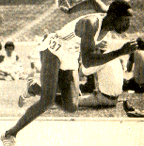 |
Interestingly, the 1500 metres has always been one of the outstanding events at every gathering of the Commonwealth athletes. With few exceptions, the worlds outstanding 1500 metre runners have come from Commonwealth countries. |
This year, the quality is even higher than usual. Connoisseurs of the event may even believe that the results will be even more impressive than the last Commonwealth 1500 metres when Filbert Bayi edged out John Walker and set a world record for the distance.
Walker and Bayi will likely be at the starting line again this year. And they'll be tough. But England has the probable winner in Steve Ovette, a young runner who, almost inknown at the beginning of the race, shattered the field with a runaway victory in the 1500 metres at last fall's World Cup competition in Munich, Germany. Ireland's Eamonn Coglan, a disappionting fourth in the Montreal Olympic event, is a strong contendor, too.
But, Canada can't be left out of this race. For the first time since Rich Ferguson went to the line with Bannister and Landy in the 1954 Empire Games, Canada has a strong 1500-metre runner. His name is Dave Hill and he comes from just outside Montreal. After getting as far as semifinals of the 1500 metres in Montreal, Hill was sufficiently encouraged to train and train even harder. Last year, he ran the fastest mile ever for a Canadian-3:55.4, definitely a world-class mark. Hill is strong over the half mile, too, so the 1500 metre distance, which is 120 yards short of a mile, could be ideal for him.
The 5,000 metres also shapes up as an excellent race. Look for England's Nick Rose to lead the field at the wire. But impressive runners like Suleimen Nyambui and Henry Rono cannot be counted out. Canada is weak in this event, even though Bruce Kidd was a formidable contendor over 5,000 and 10,000 metres only 15 years ago. (Kidd won the 10,000 metres at the 1962 Games.)
In the other track events, we are weak. And the situation is even worse in the field-except for Greg Joy and Debby Brill, two probable gold medalists in the high jump. Joy picked up the silver medal for the high jump in Montreal and Brill is always strong in the women's event. Barring injury, both are certain to win their events.
We're all wet
|
Too often, Canadians tend to believe that our country can't measure up to the rest of the world in sports. Well, when it comes to swimming, that definitely is not the case. |
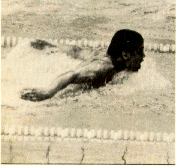 |
How well Canada will do in the XI Commonwealth Games swimming remains to be seen. Certainly, it seems that we aren't quite as strong in 1978 as we have been in recent years. But we could also slip in and steal the title from Austrailia, long one of the world's most powerful swimming nations.
As always, the best bet for Canadians is in the women's events. Wendy Hogg will be swimming in her hometown of Edmonton for these Games and that could give her just the right edge to clean up in her speciality, the backstroke. Wendy was fourth in the 100 metre backstroke and eighth in the 200 metre backstroke in Montreal in 1976 but had an off year in 1977. This year, she's been coming on strong. Early in February she showed her form by setting a Canadian short-course (a mark set in a pool shorter than the Olympic standard) record 2:14.74 for the 200 metre backstroke. The record breaks the old mark held by Nancy Garapick, Canada's sensation at the Olympics.
For the men, 18 year-old Peter Szmidt could be an upset winner. Szmidt is strong in the freestyle from the 100 metres to the punishing 1500-metre distances. His only real handicap may be inexperience in major league competition.
26 Miles of Blisters
Traditions are started in strange ways. Consider the story of the marathon, one of the world's most exciting athletic events.
The distance from Athens to the Plains of Marathon, site of the famous battle between the Greeks and the Persians many thousands years ago, is roughly 26 miles. Consequently, when the marathon was first introduced as an Olympic eventat the first modern Olympiad in Athens, in 1896, the distance was established at 26 miles.
In 1908, however, the Games were held in London, England, and a very strange thing happened. (Actually, two strange things happened. The other concerned the length of the Games. Whereas the Olympics normally last less than a month, these particular Games ran from April until October, setting another Olympic record.) The distance of the marathon was changed.
The course of the 26-mile event was carefully laid out through the streets of London. At the last minute, however, King Edward decided that he would like to see the runners. So the course was altered to take the runners past Buckingham Palace. However, in order to work in the Buckingham Palace point, it was necessary to extent the race to 26 miles, 385 yards. To this day, as marathon runners pass the 26 mile mark and head into the last agonizing 385 yards, they say earnestly:"God Save the King."
The marathon is a killing race, often made more difficult by hilly terrain. The famous Boston Marathon, for example, throws in several tough hills late in the course; it is this final hilly stretch which breaks many runners. But Edmonton is in the heart of the flattest terrain in the world. Indeed, the steepest part of the entire run is found at the entrance and exit of the stadium where, for 750 feet, there is a 5 per cent grade.
The flat Edmonton course should ensure a fast time for the event, provided the weather is not unduly warm. The race will be run at 5:30 p.m. on August 11th, which could mean that the temperature will be high (Edmonton in summer can be dreadfully warm).
Canada's best hope in this race, Toronto's Jerome Drayton will not likely run because of an injury to the hamstring muscle of his left leg which caused him to drop out of the famed Boston Marathon this year after only three miles.
The 32 year-old star who has won virtually all of the world's major marathons, including the Boston in 1977, said, "The injury is not serious but it's disabling." He plans now to concentrate on making the team at 10,000 metres.
The Games on CBC TV & RADIO
From August 3 to 12, millions of armchair spectators throughout Canada and the Commonwealth will be treated to the most comprehensive electronic coverage in the 50-year history of the Commonwealth Games.
Already being heralded as the biggest sports and cultural shebang to hit the West, the Canadian Broadcasting Corporation has undertaken the massive task of providing full color facilities for 20 television countries, and services for 35 radio countries throughout the Commonwealth, representing a potential audience of 500 million people.
"Our coverage of the Games will be unique for us," says Don MacPherson, vice-president and general manager of the CBC's English Service Division.
"At the Montreal Olympics, we used some mobile units and manpower fom the private broadcast industry. Edmonton will be our largest exclusively-CBC task to date, requiring 45 color cameras and 10 mobile units."
The CBC's special project established to cover The Games has long ago laid the groundwork to fulfill all television and radio requirements, with more than 350 employees from stations across Canada joining the special project team in July.
The broadcast centre, located in a 20 storey building in downtown Edmonton, will be equiped with 10 radio and six television studios (including $2.3 million worth of equipment purchased for the Montreal Olympics) from which programs produced will be distributed throughout the Commonwealth via Telsat's Anik domestic satellite, and through Teleglobe's Atlantic and Pacific Satellites.
The CBC's English and French Radio and Television Networks will carry six to eight hours of programming eah day and will also produce a daily evening summary of events of 30 -90 minutes duration following the National News.
The Austrailian Broadcasting Commission, the British and New Zealand Broadcasting Corporations will account for a major portion of The Games coverage.
Many countries are sending reporters for radio coverage in 11 languages during The Games, including: India, The Bahamas, Mauritius, Kenya, Paupa New Guinea, Tanzania and Malawi. Nigeria, Uganda and Ghana will also have television reporters. The Opening Ceremonies on August 3rd will take 3 1/2 hours to cover, and will provide a good example of the scope of equipment to be used at The Games. The CBC has estimated that the official opening by Her Majesty The Queen will watched by over 100 million viewers and, for that historical afternoon alone, the Commonwealth Stadium will be equiped with10 color cameras, two production videotape machines, slow motion equipment and special effects generators. To compliment the coverage, a helicopter-pac will give the television audience a bird's-eye view of the colorful opening. The helicopter-pac will also follow competitors throughout the grueling marathon, walk and cycling road race events.
Thirty-five commentator positions will be installed at the 42,500-seat Stadium. Audio or sound pickup equipment will allow each commentator to inset his own commentaries for both radio and television. The CBC will deliver all international signals(picture and sound) and individual commentaries to the broadcast centre for transmission.
The CBC Broadcast Team Canadisn viewers will see and hear from most during the 10 days of The Games are: Don Chevrier, Tom McKee, Don Whiteman and Ted Renolds, with Ernie Afaganis as anchorman.
Generation's Fearless Forecast
With many important national and provincial trials yet to be faced before Canada's Official Team of medal hopefuls head for Edmonton, TG's Sports Swamies feel akin to a palmistry reader attempting to read the lifelines of a cash customer's hand through a well-padded boxing glove.
The thin line of fate often makes the difference between a dedicated, capable competitor becoming a HERO or a bum in the collective eyes of a sometimes fickle fandom. Such as-a solo rush down the ice to score a winning overtime goal in the seventh game of the Stanley Cup, or dropping a final-out centrefield flyball in the ninth inning of the last game in the World's Series, allowing the other guys to win 2-1.
To quote the now immortal phrase of Leo Durocher, of late, great baseball managerial fame, (who must have uttered the words under extreme duress) "Nice guys finish last!"
All things being equal, and barring disasters, natural or man-made, Canada's finest will come through the ten days of grinding competition with a bagful of golds, silvers and bronze.
Familiar faces, like Joy, Drayton, Hill and Brill-Hogg, Shatto, Sawchuck and Garapick will be joined by a score of more young athletes you've never really heard of before.....and you'll cheer their achievements with a swell of national pride.
When the final grunt, splash, heave and wheeze has been oficially clocked or measured, the Maple Leaf should stand on the totals scoreboard no worse (or better) than third in rank for Commonwealth Games honours-and THAT'S our fearless forecast.
©1999 TG Magazine/Le Magazine TG
tgmag@tgmag.ca