 |
by Anonymous |
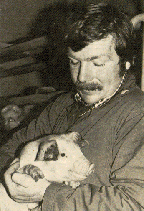
Eldon MacKay's office has carpet on the floor, plants on the filing cabinet, and pictures and posters and pinups of pigs all over the walls. MacKay likes pigs, which is fortunate because just across the farmyard from his office are barns holding 1,200 of them. They've all got their personalities, just like dogs or cats," he says.
|
MacKay (Lacombe) Farms Ltd., jointly owned by Eldon MacKay and his wife Liz, has Canada's largest breeding herd of purebred Lacombe swine, a strain developed in Alberta. Situated just outside Aberdeen in central Saskatchewan, the farm employs five people full-time, including the two owners. It's also part of a larger family farm operation. The 31 year-old MacKay operates a small farm equipment business, and his pig barns are right next to the family grain farm, run by his father. |
 |
Farming is more than just a job or a business, MacKay says: "Farming is something that has to almost run in your blood, something you're raised with." He grew up on the family farm and started raising pigs at the age of 15. After finishing high school, he attended the School of Agriculture at the University of Saskatchewan. But school is only part of a farmer's education. The farmer has to know about everything from soil quality to international markets, from fixing a tractor to handling a long-term debt. MacKay learned from his family, from other farmers, from people he worked with and things he read. And he's still learning. "A farmer, probably more than anyone else, learns things by trial and error," he ex-plains. Despite his enthusiasm for farming, MacKay almost had to give it up.
To raise good pigs you've got to treat them well
When he graduated from university, wheat and hog prices were so low there seemed to be no future in agriculture. "It looked like a prety grim situation in 1971," he recalls. So MacKay moved east to Ontario and took a job managing a temporary labor agency. After a year he moved over to the International Harvester Credit Corporation, and by 1973 he was the Toronto zone finance supervisor. "When I left there it was a $23 million a year finance business," he says.
By 1974, however, agriculture was recovering from the slump and, without hesitation, MacKay quit his job and headed home to the farm.
"My grandfather homesteaded here and my father took it over, and I didn't want to see that thrown down the drain," he explains. "It's something that I can't really put precise words to; it's just inner feelings that you have about your obligations, not to real or physical things, but to tradition itself I suppose.
|
|
Back on the farm, MacKay set out to develop a major swine operation. Today, the pigs are his pride and joy. They spend their lives in a U-shaped series of long low barns. At one end of the U are the pregnant sows and the boars, huge dignified animals who love to have their snouts rubbed or their ears scratched. At the other end are sleek market-ready pigs, six or seven months old. In between are pigs in every stage of development, down to piglets a few hours old, staggering around their mothers on four uncoordinated legs and tripping over the half-curled tails of their brothers and sisters. "My uncle refers to this place as a factory, and basically that's what it is. It's a pork production factory," MacKay explains. |
But it's a factory with a difference. A pig requires a lot more personal attention than most factory products. "It's a living being subject to the treatment it receives," MacKay says. To raise good pigs you have to treat them well, and treating 1,200 pigs well takes a lot of time. In fact, long hours are the worst part of being a farmer, MacKay adds.
Most of each morning, seven days a week, is spent feeding the animals and cleaning out the barns. The boars, the pregnant sows and the sows with piglets all have to be fed individually and checked carefully to make sure they stay healthy. Detailed records kept on each breeding pig have to be updated. The machinery has to be cleaned and maintained, and all the buildings and equipment checked regularly for wear or damage.
"In an intensive livestock operation, unless you've got the labor and the ability to pay for the labor, you can't just get away for a holiday," MacKay says.
But with a little help and good management, you can get away on business trips. In the last few years Eldon MacKay has travelled to the United States, Mexico, Italy and Germany to learn about pigs, to sell pigs and to promote the Lacombe breed. Delegations from Australia, Hungary, Brazil, Japan, the United States, Russia and Rumania have visited his farm near Aberdeen. Among his favorite visitors are the classes of school children and university students who come to learn more about a working farm. "I'm interested in them and I like it when they're interested in the farm," he explains.
MacKay says the best thing about farming is the independence. "You don't go farming on a whim any more," he warns. "Some of the decisions that are made on farms today would boggle the minds of an awful lot of businessmen, simply because of the ramifications they have and the high risk involved." But if you take the risk and make the decisions and still come out ahead, you know you've done it on your own, he explains.
The farmer also has the satisfaction of knowing that what he does is important. Not only does he provide man's most basic requirement, food, but he also supports a whole network of farm service industries employing far more people than ever set foot in a barn.
©1999 TG Magazine/Le Magazine TG
tgmag@tgmag.ca