 |
|
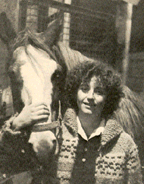
For equestrian trainer-teacher Peggy McCallum, staying in the sad-die is barely half the job. Truth is, she spends more time on the ground than on the back of a horse.
But it's all part of the job. Peggy works at the Willowbrae Equestrian Centre in Ardrossan, Alberta, a twenty-minute drive from Edmonton. Peggy is in a unique position as she is in one of the few equestrian working student programs in the country.
It means she is an apprentice to Myles and Sandy Herman, co-owners of the stable. Yet despite the connotations "apprenticeship" might imply, it is an ideal situation for someone who's been wanting to ride and work with horses since early childhood. "I was a horse-crazy kid," she says, "but living in the city, I was never any closer to horses than my uncle's farm in the summertime."
Childhood dreams occasionally blossom into reality and at age twenty-four, after heading out to be no more than a recreational rider, she decided to make riding more than just a weekend occupation.
"I discovered the stable had a working student program at about the same time as I was wanting to quit my job teaching autistic children. I was lucky, too, that the financial situation with my family allowed it."
The working arrangement is one of give and take. Willowbrae has no hired help; as a small family-owned stable, the work falls on the shoulders of family members and working students. In exchange for her work with the horses, Peggy gets a small salary, her training, and riding privileges. And as she says, you don't do it to get rich!
"I'm being trained as a rider, a trainer and a riding instructor. In return, I do stable work such as grooming, working any horses the stable might be training, teaching lessons, feeding and watering the horses, and cleaning stalls. As I gain experience in training or instructing, I can take over the simpler jobs from my instructors. For example, I can put a ride on a very quiet horse, or a green horse that doesn't need to have special or complex skills, or I can teach beginning and novice riders. This frees my instructors to work the difficult horses and teach the more advanced lessons."
Peggy says she did little specific educational preparation for her apprenticeship. She agrees that high school or university biology might help in understanding the workings of a horse, but that it's not really necessary: there is so much specific biology that can be learned on the job with the animal right there.
She has a different view of her psychology background, though, particularly that of the behavioral and learning variety. For this, her university psychology degree and work with autistic children holds her in good stead as far as training horses and riders is concerned. "When I began at the stable, I had a head start because I had the teaching skills, but not the horsemanship."
As with most jobs, working at a small stable has its good and bad moments. The money for an apprentice in Peggy's situation is not good; it's just recently that she's begun to be paid for her teaching-$25-30 per week based on the number of students in her lessons. Not exactly conducive to the possibility of her owning a horse. The hours are long, but seem minimal compared to those the owners put in.
"I'm not as involved in the stable as I might be because my husband is city-oriented. So, basically, I'm a commuter. My fifty to sixty hour week doesn't begin to compare to the sixteen hours that the stable owners put in every day."
There is a certain amount of physical danger-the usual collection of bruises and blisters from being thrown off a horse or being stepped on by a misplaced hoof. In two years of riding, Peggy's worst injury has' been a five stitch cut on a lip, courtesy of a horse's thrown-back head.
But these points are outweighed by the positive aspects of her work. She sees the stable providing a service, but yes, it is also a business. Clients bring in horses for training or to board, as well as to take lessons. It's this mixture of business and pleasure she finds intriguing.
"I'm doing something I've always wanted to do and I enjoy the contact with the animals which in Willowbrae's case also include five dogs, two cats, two pigs, a goat, a turkey, innumerable ducks, chickens and geese, and a cow and her son, the ox. I'm happy teaching people who want to learn and helping them over their fears."
For the physically-oriented, it's a golden opportunity: the stable work is enough to raise the sweat on the fittest worker, and a superb physical conditioning is both a necessity and result of the riding itself. With a program like Willowbrae's, Peggy gets as much riding in as she wants-and it costs her nothing. The horses and tack are provided, though her boots and riding clothes (for both everyday use and competition) are not.
Once you've established a professional reputation, you may be able to find a position as a trainer or instructor at other stables, as long as you are willing to relocate. You can also build on your own knowledge of training by studying for the Canadian Equestrian Federation coaching certificate, a program that requires a trainer-teacher to know advanced coaching theory and to demonstrate riding and teaching ability. If your own riding is up to snuff, you might even consider competing-an important aspect of the horse world since, as Peggy says, it develops a rider's reputation as an equestrian and "is the only form of advertising that really counts."
Peggy doesn't like scaring people away from the field, but she is adamant about the kind of people who are most liable to help both themselves and a stable. They must be patient with both animals and humans-"even though it's often the humans who can be ~ biggest pain."
They must enjoy teaching and be open-minded about their methods. If one method doesn't work, it must be replaced with another.
They must be physically fit, both for stable work and riding: that means being healthy at the very start because the work is not for the weak and weary.
And above all, they must be realistic. The full commitment is the only one that works since so many people-from the owners on down to the students spend on it. It means knowing where to draw the line as well, something Peggy says she learned before she began her apprenticeship.
"I never intend to own my own stable because, realistically, I don't want the responsibility and long hours that owning a stable would involve. But I do know that I'll always be around horses."
©1999 TG Magazine/Le Magazine TG
tgmag@tgmag.ca