 |
by Anonymous |
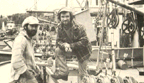
Rod Stewart's latest hit blares from the Never on Sunday, a salmon troller docked at Prince Rupert. Gerry Rose and his partner, Mark Forand, jokingly part with a little advice. "The secret ingredient to catching salmon is good rock and roll."
Actually there's a lot more involved in being a successful fisherman than one's taste in music. It takes a lot of know-how with a little luck thrown in.
Gerry was born in Nova Scotia and has fished with his father and brothers since childhood. He decided to switch from Nova Scotia halibut to B.C. salmon and arrived in Prince Rupert four years ago. "Gerry's got fishing in his blood," admits Mark, whose background is quite different. He spent five years studying English literature at McGill University in Montreal. A friend invited him to come fishing two years ago, and he and Gerry wound up on the same salmon troller. Last year they became partners and bought the Never on Sunday.
"Trolling is totally different from East Coast fishing," states Gerry. "It's like a trade." Both men apprenticed with an old-timer captain in Prince Rupert. "First you've got to like fishing and then it's easy to catch on," laughs Gerry.
Gerry and Mark normally fish from May through to September and, if the catch has been lucrative, they take off for the winter. "We're not into 9 to 5 jobs. We'd rather work hard for 20 hours a day during the salmon season and then relax." Sometimes they work on herring boats over the winter months for extra cash.
During salmon season, Gerry and Mark stay out at sea about two weeks at a time, or "until we get sick of it." A good catch they figure is about 10,000 pounds. They belong to the Prince Rupert Fishermen's Co-op Association. You deliver your catch to the Co-op and they pay you a percentage. After the fish are sold and overheads are covered, the fishermen then receive a part of the overall profits. It's a guaranteed market. Salmon is sold by the pound, and there are different grades. They get top dollar for sockeye.
A typical day at sea is a long one. Mark and Gerry rise at 4 a.m. and don't usually hit the sack until about 11p.m. Gerry yawns. "We have to get up early to listen to the weather report so we can decide where we'll fish for the day. By 10 a.m., we've already been working for six hours and we're starving." It's Mark's job to prepare a huge breakfast.
Apart from hooking the lines and dressing the salmon, there's a lot to be done on a boat. "We try to do preventative maintenance constantly so nothing serious goes wrong at sea. The boat takes a real beating in all this rough weather, especially over the winter." Mark, while inspecting the shackle pins and rigging, states, "All worn parts must be replaced and you have to carry spare parts on board." Gerry and Mark do minor boat and engine repairs themselves, but for major work they hire expert mechanics or electricians. Fishing is an expensive proposition, you are constantly having to replace wires, hooks, lures, etc. All commercial fishing vessels must also be licensed according to the size and type of fishing boat. The Never on Sunday has an 11 ton salmon trolling license. "A few years ago the government limited the number of licenses to be issued and fees have skyrocketed since then," Mark complains.
"There's a lot more to trolling than just dragging gear," Gerry explains. "You've got to know what spot to pick and what to look for ~ the birds are a good sign. Also, markings of small fish on the boat's sounder (depth finder) are good indications. You've also got to be aware of the tides. Salmon feed when the tide is still, just before it changes. You must be in the right spot at the right time."
Fellow fishermen are always helpful to a boat in trouble, but they probably won't tell you where they caught their fish. "We all have our favourite secret spots," confides Mark.
Fishing is one way to get your adventure while making your money. There are always emergencies. Gerry reminisces about a time when a pole broke and all the rigging got tangled in the wheel. "I had to climb the mast and saw off the pole with the winds blowing at 35 MPH and huge waves tossing tne boat around."
"The first time I trolled I had to pump for five straight hours," Mark remembers. "It was stormy and we took on a lot of water and the automatic pumps wouldn't work. I didn't even realize we were sinking. There's a saying amongst seasoned fishermen, that the only people who don't get scared are fools and greenhorns. You've got to be aware of the problems but, at the same time, you have to keep cool and don't panic."
Most boats have a captain with a crew working under him. "We have a different system because we're equal partners and we do equal work," explains Mark, "and we really do get along very well-it's a necessity in such close quarters."
To anyone interested in fishing as an occupation, the partners have some advice. "You've got to be prepared to pound the docks. Some people get hired right away and others never seem to get on a boat." What does a captain look for? Someone who seems quick and keen and who has physical strength. "You start at the bottom as a deck hand and you really work. A deck hand is expected to cook, wash dishes, catch fish, and dress and ice the entire catch. You are on-the job 24 hours," advises Gerry.
It seems that Gerry and Mark have no intention of changing occupations. "I guess if I could make rock star wages doing something else, I'd switch jobs," laughs Mark, "but I do well here and I like it. There are no guaranteed wages in fishing, it's a gamble, but you push yourself to work hard and if it pays off there's a strong feeling of self-satisfaction. It's great for developing strength of character."
©1999 TG Magazine/Le Magazine TG
tgmag@tgmag.ca