 |
By Deborah Styles
|
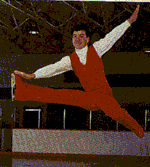
The Rink is black, the crowd is hushed. When the lights come up we see a sleeping hobo, who wakes up and rises unsteadily to his skates, but miraculously doesn't fall. For the next few minutes the audience laughs at the antics and near-misses of this lovable skating clown. And next, the skater performs flawlessly an intricate program of jumps and spins that he hopes to use at the next World Championship. A little later, this same skater performs a romantic duet with great sensitivity.
This is Elvis Stojko, performing at the Mariposa School of Skating's benefit evening for the local hospital. He has earned the standing ovation he receives.
Stojko was just a toddler when he saw someone spin on the ice, and from then on he badgered his parents until they allowed him to start lessons at age five. Four years later he was winning solo competitions.
Now, Stojko commutes from his Richmond Hill home two hours daily to train at a superior training facility, the Mariposa School of Skating, in Barrie, ON.
Skaters must audition to train with Mariposa. "Our students must have commitment and a desire to win," says owner/director Doug Leigh. "We don't always take the skaters who have raw talent. I look for people who believe in themselves and are willing to work hard to achieve their goals. They have to really want it." Leigh knows what he's talking about-he was Brian Orse's coach when he won the 1987 World Championship and 1984 and 1988 Silver Olympic medals.
Leigh feels the international flavour of the school, benefits all the skaters. On any given day the Finnish Men's' champion, Oula Jaaskelainen; the Finnish Women's Champion, Mari Niskanen; and the Swedish and Scandinavian Women's Champ, Helene Perrson are likely to be on the ice with Canadian skaters.
"They work together and learn from each other. They are exposed to cultures thoughts, feelings, and find out what makes the whole world tick because it's right here in front of them," says Leigh.
"Winning Starts Here" is emblazoned over the doors of the rink and the dance studio, an encouragement to the skaters as they go about their rigorous training schedules. Summer is the most intense training time at Mariposa; skaters train on and off the ice from 7 a.m. till 3 p.m. five days a week.
Between the two-hour sessions on the ice, skaters change to sweats and dash upstairs to the dance studio for a 90-minute exercise session. The music is raucous and the energy level is high as they go from floor exercises to push-ups, to sit-ups, and hop or jog around the room to various stations.
Stojko has opted out of these sessions, preferring to get his off-ice exercises from martial arts training four times a week. He earned his black belt in karate two years ago, and finds the two sports are compatible. "Karate and skating both require flexibility and help build power in the legs without building bulk," he says
Stojko's training has paid off. He was only 17 years old when he ranked ninth at the World Championships in Halifax in 1990, where Canadian Champ Kurt Browning was the winner. This March Stojko upped his ante to 6th place and history-making quadruple toe-loop, double toe-loop combination jump.
Stojko used international competition to learn from the seasoned world-class competitors. "As I skated I kept saying to myself, 'Wow I'm at the World Championships.' I was freaked out by the hole thing but I loved it."
Aside from skating, Elvis maintains a B average in high school and plans to take a university business program next fall. "I love to skate, but skating cannot be my whole life," he says.
Although he's considered to be the 'up and comer' in the skating world, Stojko knows that any future he might have as a professional depends on how well he does as an amateur. He wants to have a back up plan.
Needless to say, Elvis has a busy year ahead, but he's not complaining. "If I don't smile while I'm on the ice it's because I'm concentrating too much. Eventually I know I'll get it together."
©1999 TG Magazine/Le Magazine TG
tgmag@tgmag.ca