 |
By Deborah Styles |
Justice takes many forms in Canada. Once apprehended, an offender enters a system that's multilevel; includes jails, prisons, halfway houses, minimum and maximum security facilities, addiction programs, probation and parole. Each lawbreaker is dealt with individually.
Offenders can start out in a provincial holding center. A provincial court is much like a 'for' and 'against' system with a defense lawyer and Crown Attorney ( the lawyer who represents the court) arguing innocence and guilt, a clerk to record it all, and sometimes members of a jury.
The sentence for a guilty person might be a fine, probation, jail sentence, or a combination of all three.
Judges pass sentences based on guidelines from the Criminal Code. If you break a window, the sentence is much less than if you leave the scene of an accident. Prisoners go either to a provincial or a federal facility, depending on the length of their sentence (under or over two years).
If you work in the corrections field, whether it's as a court illustrator during trials, or as a guard, you'll be working for territorial , provincial or federal jurisdictions, but the jobs are similar.
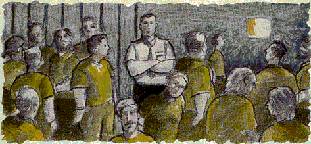
Correctional officers, case managers, residential care workers all supervise prisoners while they're in prison. Psychiatrists, psychologists, social workers, probation officers, placement and parole officers work to help offenders move back into the community and stay out of trouble.
Crown Attorney John Alexander says the need for correctional workers is growing. "More laws are being enforced, not just because government passes new ones, but because society looks more and more to the courts to take care of problems such as drinking and driving. Years ago victims of incest and sexual assault were reluctant to come forward but now they're more likely to report crimes. This means we prosecute more offences, and we need more services for those offenders."
If you're a person who can treat people as individuals, and separate the person from the action, the corrections field might be right for you. Workers' emotions may run the gamut from revulsion to pity, but feelings can't get in the way of the job.
Across Canada, colleges and universities are recognizing the need for special study in the corrections field. It's easier now to select a program that will prepare you for a specific job.
tgmag@tgmag.ca